How The Build Works#

1. Header and Source Files (Your Input Code)
These are the starting point — your .cpp and .h files. They contain the logic, declarations, and definitions that make up your program.
2. CMake (The Build Configuration Tool)
CMake is like the project manager. You give it a high-level description of your project via CMakeLists.txt files:
Which source files exist
What targets (executables, libraries) to build
What compiler flags or definitions to use
What dependencies to link
CMake does not build anything itself. Instead, it generates files for the actual build system you’ll use.
3. Generators (The Output Format Specifier)
CMake uses a generator to determine what kind of build system files to produce.
Examples of generators:
Unix Makefiles → Generates Makefiles for use with make
Ninja → Generates build.ninja files for ninja
Visual Studio → Generates .sln and .vcxproj for MSVC IDE
You pick the generator depending on your platform or preference.
4. Build System (The Build Executor)
This is the tool that actually performs the build steps by following the instructions CMake generated:
Make reads Makefile
Ninja reads build.ninja
Visual Studio/MSBuild reads solution/project files
It calls the compiler, tracks dependencies, and decides what needs rebuilding.
5. Compiler (The Code Translator)
The compiler (e.g., g++, clang++, cl.exe) compiles individual .cpp files into .o/.obj object files.
The compiler is invoked by the build system — not directly by CMake (except for test detection and introspection).
6. Linker (The Final Assembler)
After all source files are compiled, the linker combines them:
It links object files and libraries into a single executable or shared/static library.
It resolves symbols and dependencies.
The linker is usually invoked as part of the compiler toolchain (g++ or clang++ often handle linking too).
Each component hands off its results to the next — forming a pipeline from code to binary.
Summary#
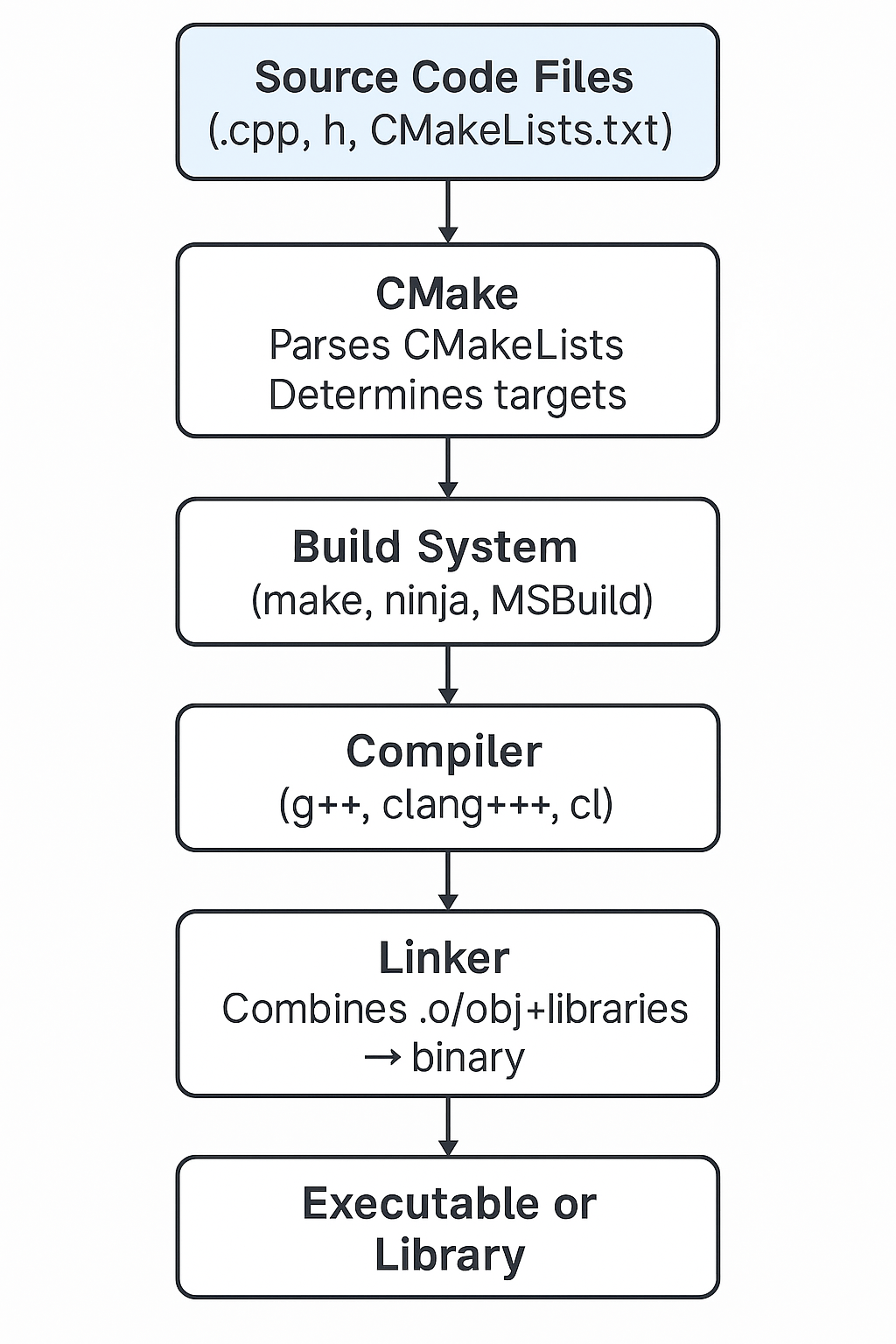
Component |
Responsibility |
|---|---|
Header/Source |
Contains code logic and declarations |
CMake |
Describes project structure/configuration |
Generator |
Chooses format for build system files |
Build System |
Executes compilation and linking steps |
Compiler |
Translates source code into machine code (object files) |
Linker |
Combines object files into final output |